
Cost Savings is the fifth pillar in the 7 Cs of Retail Consumables because savings are not achieved in isolation. They are the result of better control, clarity, centralisation and consolidation.
In retail, pressure on margins is constant. Rising operating costs, supply chain volatility and increasing regulatory demands mean every area of spend is under scrutiny. Yet operational consumables are often overlooked, seen as low-value, unavoidable or too complex to optimise.
Consumables rarely appear on strategic agendas because they do not fail dramatically. Instead, they create a steady drift in cost, small inconsistencies multiplied across every store, every week and every order.
In reality, consumables represent one of the most controllable areas of indirect spend. When poorly managed, they quietly erode margin through duplication, inefficiency and waste. When managed well, they protect profitability and release capital back into the business.
Unlike products for resale (GFR), most consumables (GNFR) are purchased frequently and in smaller values. This makes inefficiencies harder to spot, but no less impactful at scale.
Common challenges include:
Individually, these issues may seem minor, but across a large retail estate they compound quickly. Research into indirect spend consistently shows that categories lacking visibility and ownership are where the greatest inefficiencies accumulate.
Cost savings are traditionally associated with cutting back. In practice, sustainable savings come from efficiency, consistency and better decision-making.
In a retail consumables context, cost savings mean:
What cost savings are not:
In a high-cost environment, margin protection depends less on dramatic cost-cutting and more on eliminating silent inefficiencies across controllable spend categories. The most effective strategies improve how consumables are managed, not just how much is spent.
According to The Centre for Retail Research, 57 UK retailers closed in 2025 as operating costs continue to rise. In this environment, controllable operational costs take on even greater significance.
Sustainable cost savings require structural change. Procurement platforms such as MyAcopia enable retailers to address the root causes of margin leakage rather than applying short-term fixes.
By centralising and consolidating consumables purchasing, retailers can bring demand together across locations, supporting:
Better visibility of usage and ordering patterns also reduces the tendency to order defensively. This allows retailers to:
These savings often go unnoticed, yet they have a direct impact on the bottom line.

Cost savings in consumables are rarely isolated to procurement. When margin improves here, the financial benefit is felt across operations, finance and sustainability.
By replacing fragmented processes with a single platform, retailers reduce administrative burden and free teams to focus on higher-value activity. This operational efficiency contributes to long-term cost control.
Effective cost control is not simply about reducing spend. It is about managing purchasing in a structured and transparent way so that costs are predictable, waste is reduced and resources are used more efficiently.
It is also important to recognise that cost is not only measured in pounds spent on products — time and effort matter too.
Improved cost control delivers benefits across the business:
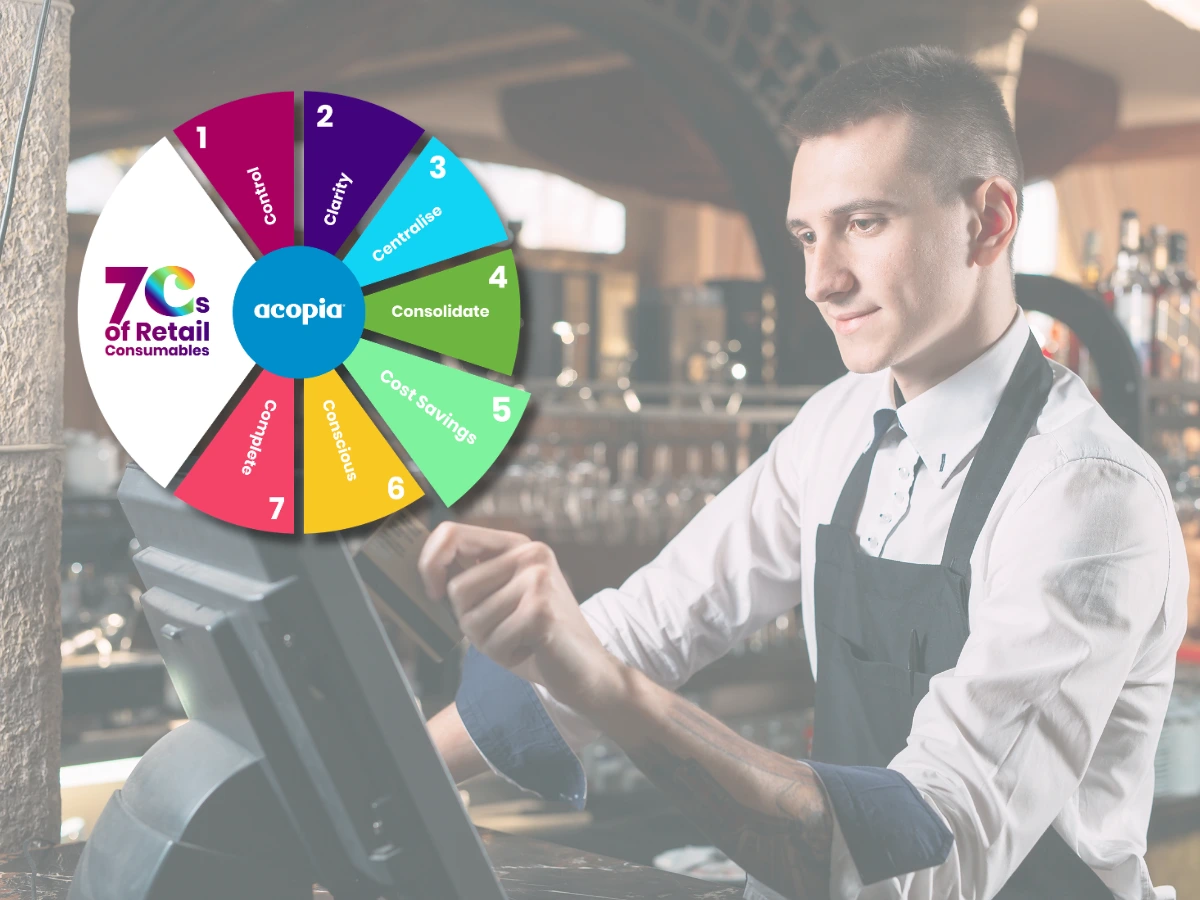
Cost savings build on Control, Clarity, Centralisation and Consolidation. They are the result of these preceding disciplines.
Once retailers understand what is being purchased, have visibility into usage and have simplified supplier and product landscapes, savings become both achievable and sustainable.
This enables retailers to:
Without these foundations, cost reduction efforts risk being short-term and disruptive.
Improved cost control results in smoother operations, stronger financial planning and more responsible resource management.
Retail consumables may not be headline spend categories, but they have a real impact on margins. Hidden costs created by inefficiency, fragmentation and waste erode profitability over time.
In a margin-constrained retail environment, the retailers that succeed are not those who cut indiscriminately, but those who manage deliberately.
Cost savings within the 7 Cs framework are not about reduction alone. They are about protection, control and sustained margin improvement. By managing consumables more effectively, retailers can transform them from a hidden cost into a strategic lever for profitability.