
Preventing retail consumables stockouts isn't about simply holding more stock.
It's about knowing what each store needs, how quickly it's being used and when it needs to be replenished. By using actual consumption data, setting sensible stock levels and having a clear view of inventory across every location, retailers can spot potential shortages before they become a problem. A centralised procurement platform can help bring this information together, giving procurement teams greater visibility and control across the entire estate.
Because the earlier you know you're going to run out, the easier it is to prevent it.
When retailers talk about stockouts, the conversation will most likely focus on the products out on the shop floor, the Goods for Resale (GFR).
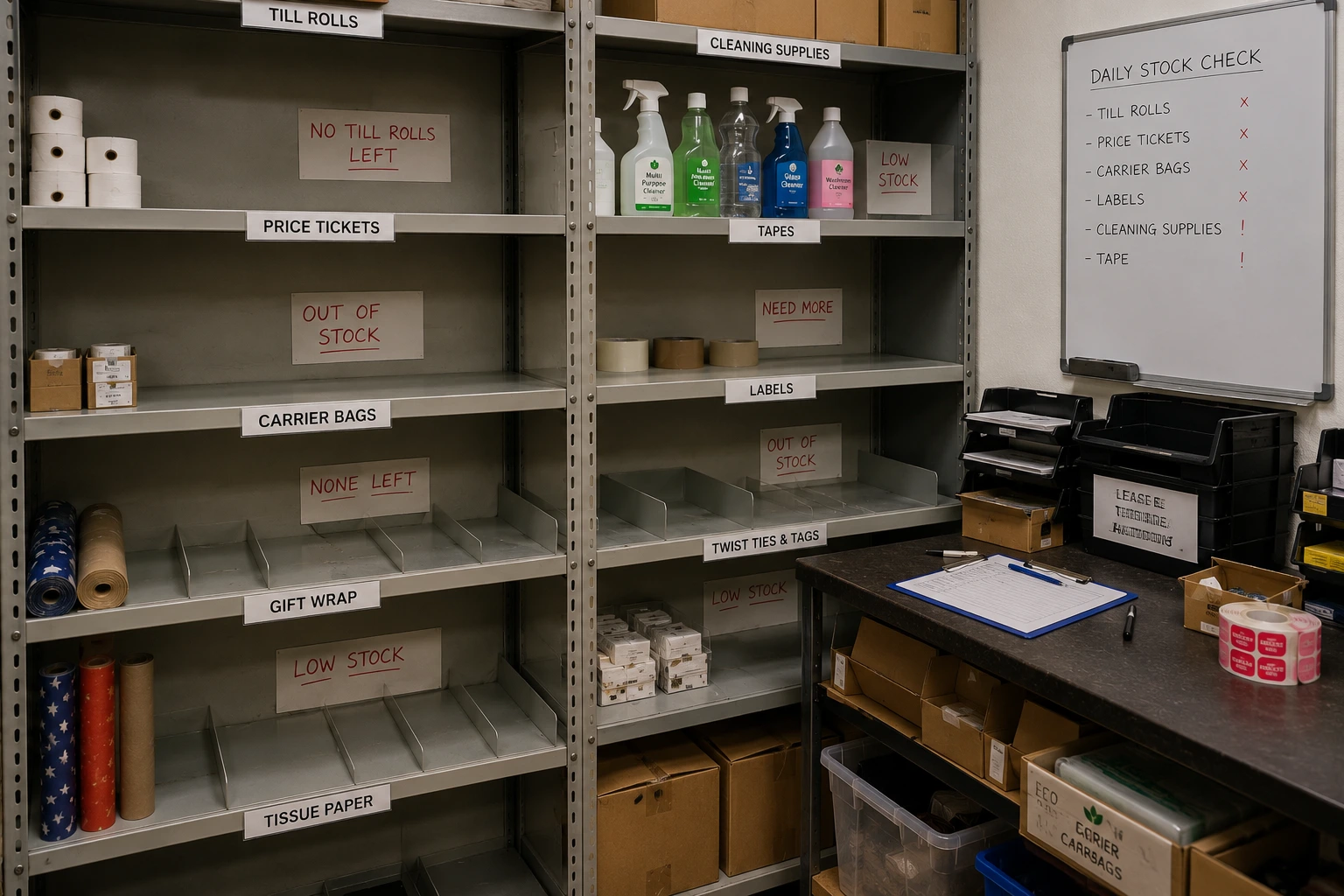
But some of the most disruptive stock shortages actually happen behind the scenes, in Goods Not For Resale (GNFR). These could include items such as garment labels, retail carrier bags, till rolls, cleaning products or hangers.
These aren't revenue-generating products, but without them, every store will struggle to trade efficiently.
Across large retail estates, even a minor shortage can quickly escalate, resulting in frustrated store managers, emergency deliveries, inconsistent customer experiences and unnecessary operational costs.
Imagine a retailer running out of till rolls or carrier bags. It doesn't take a lot to bring a customer queue to a standstill.
The real problem isn't the till rolls or carrier bags, it's not knowing you were about to run out.
As retailers continue to operate under intense cost pressure throughout 2026, preventing retail consumables stockouts has become a critical part of effective retail supply chain management.
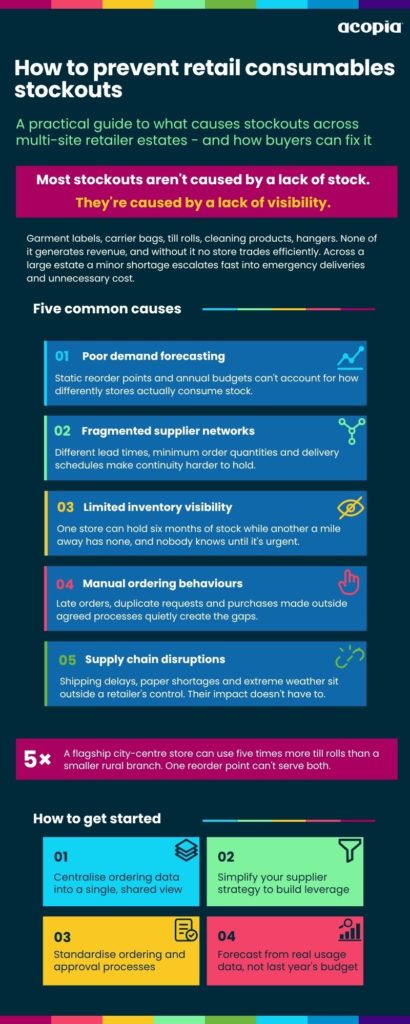
Fortunately, most stockouts aren't caused by a lack of stock.
They're caused by a lack of visibility.
Unlike merchandise, consumables often receive very little strategic attention and ordering is often decentralised.
Forecasting is based on historic ordering rather than actual usage. Different suppliers may manage different product ranges that are re-ordered out of habit, generally because it seems easier to do so.
Stores hold varying levels of safety stock, and the result is a supply chain that is reactive and based on assumptions rather than planned.
As Chris Rigg Procurement Specialist from Revalute (Dobbies, Proxima) explained during Acopia's recent retail live panel: Where Retailers Are Losing Margin (and How to Fix It!)
"The data for me has always been key. What is it? What's the product, what's the volume, how much does it cost you?"
Without that visibility, procurement teams often find themselves making decisions with no sight of usage data.
Many organisations still replenish consumables automatically, regardless of actual need or usage.
The problem?
Stores don't consume materials equally. A flagship city-centre location may use five times more till rolls than a smaller rural branch. Seasonal peaks such as Christmas, back to school, Black Friday and other promotional events also change consumption dramatically.
Without dynamic forecasting, stores can either over-order or run out completely.
Many retailers still source consumables from multiple suppliers. Cleaning products from one, perhaps packaging and office supplies from another. Now throw in the complexities of different:
The more suppliers that are involved, the harder it becomes to maintain continuity.
Zara Owen, Retail Operations Manager at The Body Shop, highlighted the opportunity retailers often overlook:
"How many vendors are you being serviced by? Is there anything else you could be doing with those vendors that actually leverage those relationships?"
One store may hold six months of stock, while another a mile away has none.
Without central visibility, procurement teams rarely know this until someone raises an urgent request.
Joe Pennington, Retail Director at ReBo Solutions (ProCook, Charles Tyrwhitt) emphasised the importance of everyone working from the same information:
"Having that single view, everybody talking about it in the same language, and getting together regularly to make sure that the format's in place."
This “single source of truth” allows procurement, operations and stores to identify shortages before they become emergencies.
Many stockouts originate from inconsistent ordering habits rather than genuine consumables shortages. Busy store colleagues put in late orders. Sometimes duplicate requests are submitted. Emergency purchases are made outside agreed processes.
Chris Rigg described how everyday purchasing behaviour quietly increases costs and erodes margins.
"People have in their mentality the Amazon one-click philosophy and they take that into the workplace."
Standardised ordering and approval processes reduce these inconsistencies while improving inventory management.
Even the best-managed retailers remain exposed to wider market pressures such as global shipping delays, paper shortages, extreme weather or geopolitical disturbances. These all constrain manufacturing capabilities.
While retailers can't prevent external disruptions, they can reduce the impact by working with a smaller, more consolidated supplier base gaining the leverage and reliability benefits described above.
Cost-effective ordering needs to be based on actual numbers. Using a centralised procurement platform can show stock levels by location, usage trends, unusually high consumption and where there are slow-moving products or ordered items that aren't being used.
Good decisions start with good data.
Preventing stockouts starts with understanding what you're buying, where it's going and how quickly it's being used. Here are six practical steps retailers can take to gain greater control:
1. Map your suppliers
Start by understanding how many suppliers are servicing your estate and what you're buying from each one.
Look for duplicated products, overlapping ranges and categories being supplied by multiple vendors. Consolidating these can simplify ordering, reduce the number of deliveries into stores and give you greater leverage with the suppliers you choose to retain.
2. Understand consumption
Historic ordering doesn't always tell you what a store actually needs.
Look at consumption by product and location to understand how quickly different consumables are being used. This makes it easier to spot unusually high usage, identify slow-moving stock and forecast future demand based on what's actually happening across the estate.
3. Set stock levels
Not every store needs to hold the same amount of stock.
Set minimum and maximum stock levels based on actual consumption, supplier lead times and the needs of each location. For business-critical consumables, you may also need additional safety stock to protect stores against unexpected increases in demand or delays in supply.
The aim isn't to hold more stock. It's to hold the right amount in the right place.
4. Create one view of inventory
If procurement can't see what's happening at store level, it's difficult to identify a potential stockout before it happens.
Bring stock levels, orders and consumption data together so procurement and operations teams can see where stock is sitting, where usage is increasing and which locations may be at risk of running out.
That visibility also makes it easier to identify situations where one store is holding excess stock while another is running short.
5. Prioritise critical items
Not every consumable carries the same operational risk.
Running out of one cleaning product may be inconvenient. Running out of till rolls, carrier bags or essential labels could have an immediate impact on a store's ability to trade.
Identify your business-critical consumables and give them greater attention when setting stock levels, monitoring usage and planning for potential supply disruption.
6. Review regularly
Stock requirements don't stay the same.
Monitor consumption, stock levels, emergency orders and supplier performance regularly. Look for patterns and exceptions, then adjust stock levels and forecasts as demand changes.
The objective is to identify the problem while you still have time to do something about it
As Zara Owen put it "It's about getting the value for money from the people that you're doing business with."
Preventing stockouts isn't simply about buying more stock.
It's about:
The retailers that outperform their competitors in 2026 won't simply be those spending less on consumables.
They'll be the ones managing them with greater control, better data and complete visibility across every store location with the same discipline they already apply to goods for resale.
Want to see where the hidden stockout risks sit in your own estate? The Retail Consumables Maturity Index Assessment takes just five minutes to complete and highlights the quick wins, opportunities and gaps for your operation.