

Retail consumables are the everyday essentials that keep stores running, from till rolls and carrier bags to cleaning products and packaging. Across a large retail estate, how those products are bought, managed and distributed can have a bigger impact than you might think. Get it right and you can reduce costs, prevent stockouts and get a much clearer view of what's happening across every store.
Till rolls that run out mid-queue. Cleaning stock overordered at one site, stockouts at another. A regional manager fielding the same "we've run out of bags" call for the fifth time this month. If any of this sounds familiar, you're not managing your retail consumables.
They're managing you.
Consumables don't sit at the top of anyone's priority list. They sit in the goods not for resale (GNFR) category most teams don’t see it as core to their business. But multiply a small inefficiency by 200, 500, or 1,000 stores, and suddenly the financial impact is seen as too big to tackle.
So where do you start?
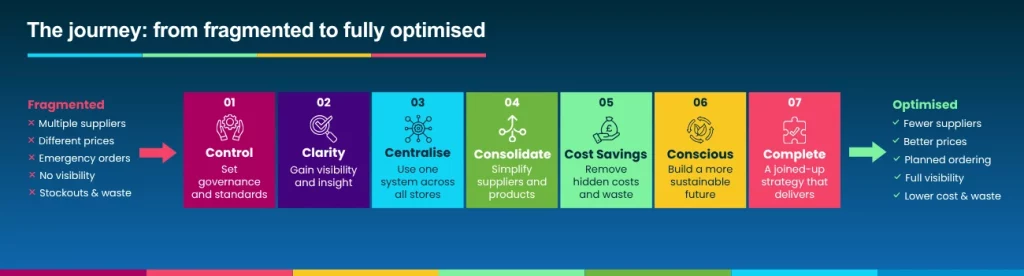
Here's the framework we keep coming back to when we work with multi-site retailers: the 7 C's of retail consumables management, built to strip back the complexity to one shared view.
"So for me, certainly it's about consolidating, simplification, visibility, improving inventory management - and that's across product as well as the consumables. It's about having that one source of truth across the business." Zara Owen, Retail Operations Manager at The Body Shop
1. Control retail consumables across your sore estate
Control starts with governance: clear ownership, consistent processes and a single set of approved products across the entire estate, rather than 300 stores each making their own decisions.
"It gives me greater control over what is purchased, with no unnecessary stock-piling." Rainbows Hospice, on MyAcopia, a bespoke retail operational consumables management system
2. Clarity on retail consumables spend and usage
You can't manage what you can't see. Estate-wide visibility of consumables spend, usage patterns, and supplier performance turns consumables procurement from purely a cost exercise into a source of insight, flagging which stores are overordering, which suppliers are underperforming, and where the next saving is hiding.
"Behaviour. History. Lack of data. It's all there... And just getting the basics of what you've spent your money on, what unit price, what volume that tells the whole story." Chris Rigg, Revaluate
3. Centralise consumables ordering
If store teams are ordering consumables through a mix of local suppliers, cash-and-carry runs, and the odd emergency Amazon order, there's no single version of the truth, and consequently no leverage. One online ordering system, used consistently across every site, is what makes retail inventory control actually possible.
"MyAcopia really did streamline our ordering process. Not only could they supply our store consumables, but they could do carrier bags too, and we could buy them in bulk, store for free, and deliver for free." Mark Swinden, ALDO
4. Consolidate suppliers and product ranges
Fewer suppliers and a simplified, pre-approved product range can sound ambitious. But this is where real supply chain efficiency gets unlocked: less admin, fewer invoices to reconcile, and stronger commercial leverage because volume is no longer scattered across dozens of local accounts.
"I don't think it's necessarily all about change, but it's continuing to consolidate and simplify what you're doing." Zara Owen, The Body Shop
5. Cost Savings on retail consumables
Cost savings aren't created by negotiating one better price. They're achieved by removing hundreds of small inefficiencies that quietly drain margin every day. This is where the first four C's pay off. Clear ownership, consolidated suppliers, centralised ordering systems, and clean data expose the hidden inefficiencies in the express deliveries, the duplicate accounts, the same product bought at three different prices. This all quietly erodes margin across a large estate.
"What is it? What's the product, what's the volume, how much does it cost you? It doesn't need to be overly complex. If you get the basics right, then the rest of it tends to follow." Chris Rigg, Revaluate
6. Conscious
Increasingly, retailers are expected to balance commercial performance with environmental responsibility. A conscious consumables strategy delivers both, this means auditing packaging, reducing waste at source, and choosing suppliers who can prove their track record, not just claim it
“The bags from Acopia make sorting and storing donations incredibly straightforward and they’ve given a real boost to our sustainability credentials” Trish Cook, The Children’s Society.
7. Complete
The final C isn't another initiative. It’s the outcome of getting the previous six right. Does it add up to a joined-up strategy, or six separate initiatives running in parallel?
A complete approach means operations, procurement, finance, and sustainability teams are working from the same data, the same supplier list and the same priorities.
None of these work in isolation. The retailers seeing the biggest gains treat consumables as a governed category, not a series of one-off fixes.
Where to start
If you're a retail operations or procurement leader reading this on a Monday morning, start here:
Effective retail consumables management comes down to controlling what stores buy, creating visibility over spend and usage, centralising ordering, consolidating suppliers, reducing unnecessary costs and waste, and bringing it all together under one estate wide strategy.
If you’re looking to take greater control of consumables across your retail estate, our team of experts are here to help.
Retail consumables management will never make headlines. Get it wrong across a large estate and you'll pay for it in margin, compliance risk, waste and cost.
Get it right and everyone benefits.
For further reading and insights, download our eBook on the Complete 7Cs of Retail Consumables Management here