
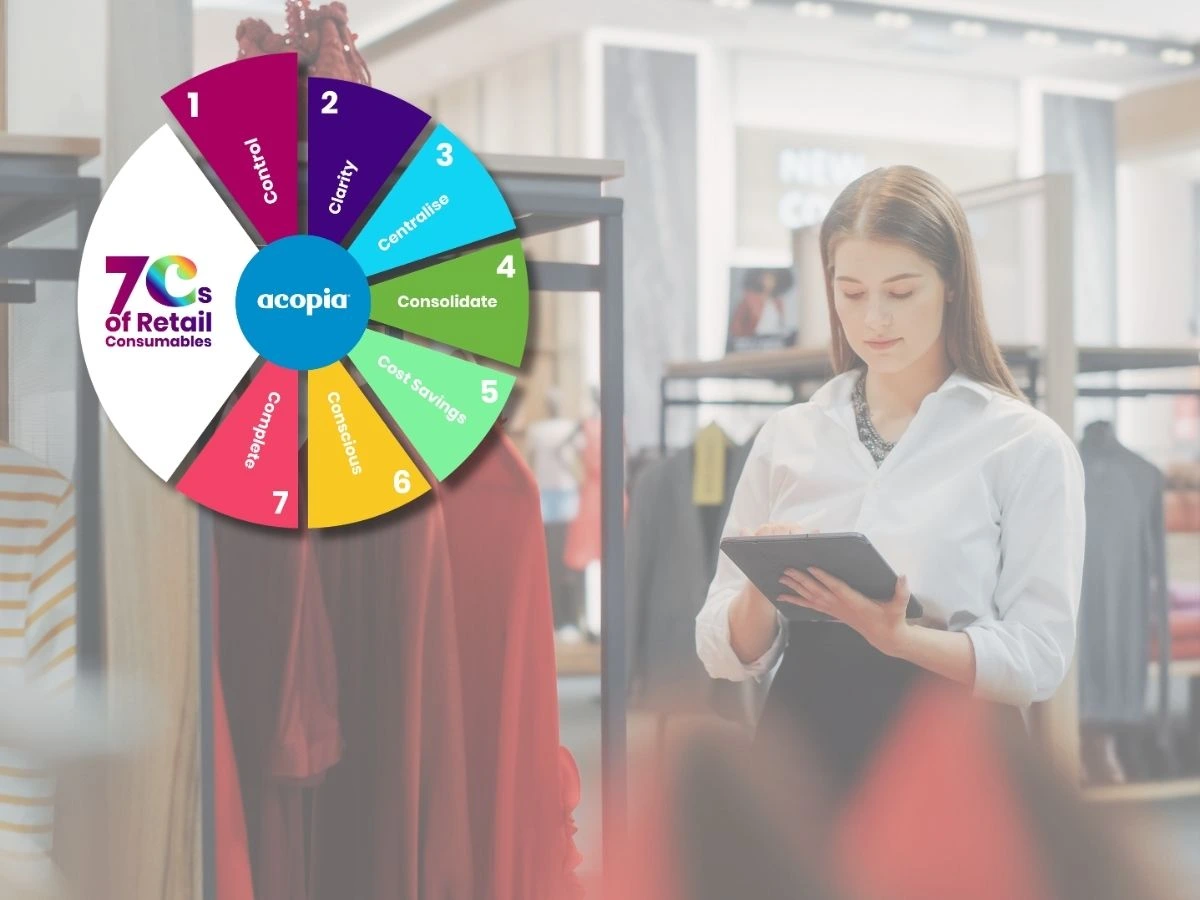
The first C in the 7 C's of retail consumables
Introduction
Retail consumables are essential but when they’re poorly controlled, they quietly drive-up costs, create inconsistencies and undermine sustainability goals. Control is the foundation of smarter consumables management. There is a clear challenge in gaining visibility of managed ordering, to have better budget oversight to support operations, procurement, finance and sustainability teams to take back control and set the stage for meaningful cost savings and waste reduction.
Control is the first pillar in the 7 Cs of retail operational consumables. Because without control, every other improvement becomes harder to achieve, co-ordinate or manage.
Controlling retail consumables procurement
Retail teams spend countless hours optimising the customer experience, driving sales performance and managing complex supply chains for Goods For Resale stock. Yet one critical area is often left unmanaged: operational consumables.
From carrier bags and gift wrap to cleaning products, labels and packaging, consumables quietly drain budgets, fragment processes and introduce risk when they are not properly controlled. Many Retailers accept this as “just the way it is” but it doesn’t have to be.
When retail consumables control you
Across multi-site retail estates, operational consumables are essential to daily retail operations, but they are rarely treated with the same discipline as core stock or goods for resale.
Across multi-store Retailers, common challenges include:
According to the Chartered Institute of Procurement & Supply (CIPS)1 a lack of visibility and governance is one of the leading causes of maverick spend and purchasing that falls outside agreed processes or suppliers.
In short, when consumables aren’t controlled, they start controlling you: your time, your budget, your storage space and your operational performance.
What “Control” really means in retail
Control is often misunderstood as restriction. In reality, effective control is about consistency. In a retail consumables context, control means:
This level of control allows Retailers to move from reactive purchasing to planned, informed management, a shift that procurement and finance leaders increasingly demand in today’s margin-pressured environment.
The hidden retail costs of losing Control
The financial impact of poorly controlled consumables, or GNFR is rarely visible on a single line of a budget, but its effects are cumulative and costly.
When control is lacking, Retailers often experience:
From a sustainability perspective, over-ordering directly contributes to unnecessary waste, an issue increasingly scrutinised by regulators, investors and consumers alike. The UK Government’s Resources and Waste Strategy for England 2 highlights the need to reduce waste through better resource efficiency, while the British Retail Consortium (BRC)3 has repeatedly emphasised the responsibility Retailers have to minimise operational waste across their supply chains.
Control isn’t about doing less. It’s about doing things properly, once.
How Retailers can regain Control
Operational consumables management platforms, such as MyAcopia, are designed to give Retailers practical, day-to-day control over their operational consumables without adding complexity.
Bespoke and integrated platforms can provide a structured environment that supports better decision-making at every level and for all users, whether at Head Office or in the store.
"It gives me greater control over what is purchased with no unnecessary stock-piling"
Rainbows Hospice on MyAcopia, the bespoke retail operational consumables management system
Central visibility across your retail estate
By using a procurement platform for operational consumables, Retailers can gain a single view of purchasing behaviour activity right across their business.
Teams can see:
This visibility removes guesswork and creates accountability, two essential foundations of control.

Controlled ordering without operational friction
Control doesn’t mean slowing teams down. Instead it allows Retailers to put smart controls in place that guide ordering behaviour without disrupting operations.
This includes:
The result is fewer unagreed purchases and greater product consistency across stores.
Show your budget who’s boss
One of the biggest frustrations for finance teams is unexpected consumables spend.
Procurement platforms support stronger budget control by:
Instead of reacting to overspend, teams can work towards preventing it in the first place.
Control that works for every retail stakeholder
One of the strengths of MyAcopia is that control benefits every function, not just procurement.
Retail Operations
Procurement
Finance
Sustainability Teams
Control becomes a shared advantage, not a departmental burden.
Control: The first step in the 7 Cs journey
Control is the foundation upon which the other 7 Cs of retail consumables management are built.
Without control, it’s impossible to:
By starting with Control, Retailers put themselves in a position to unlock the full value of their consumables strategy.
Take back Control
Operational consumables may not be customer-facing, but their impact on cost, efficiency and sustainability is significant.
Retailers that continue to manage consumables in a fragmented, reactive way will face rising costs and increasing complexity. Those that take control will gain visibility, confidence and long-term value.
Don’t let your operational consumables call the shots. With MyAcopia, you can take Control and build a smarter, more resilient approach to retail consumables.
Download this blog and share with colleagues
References