Using Acopia’s 7Cs framework to diagnose where multi-site process improvement breaks down
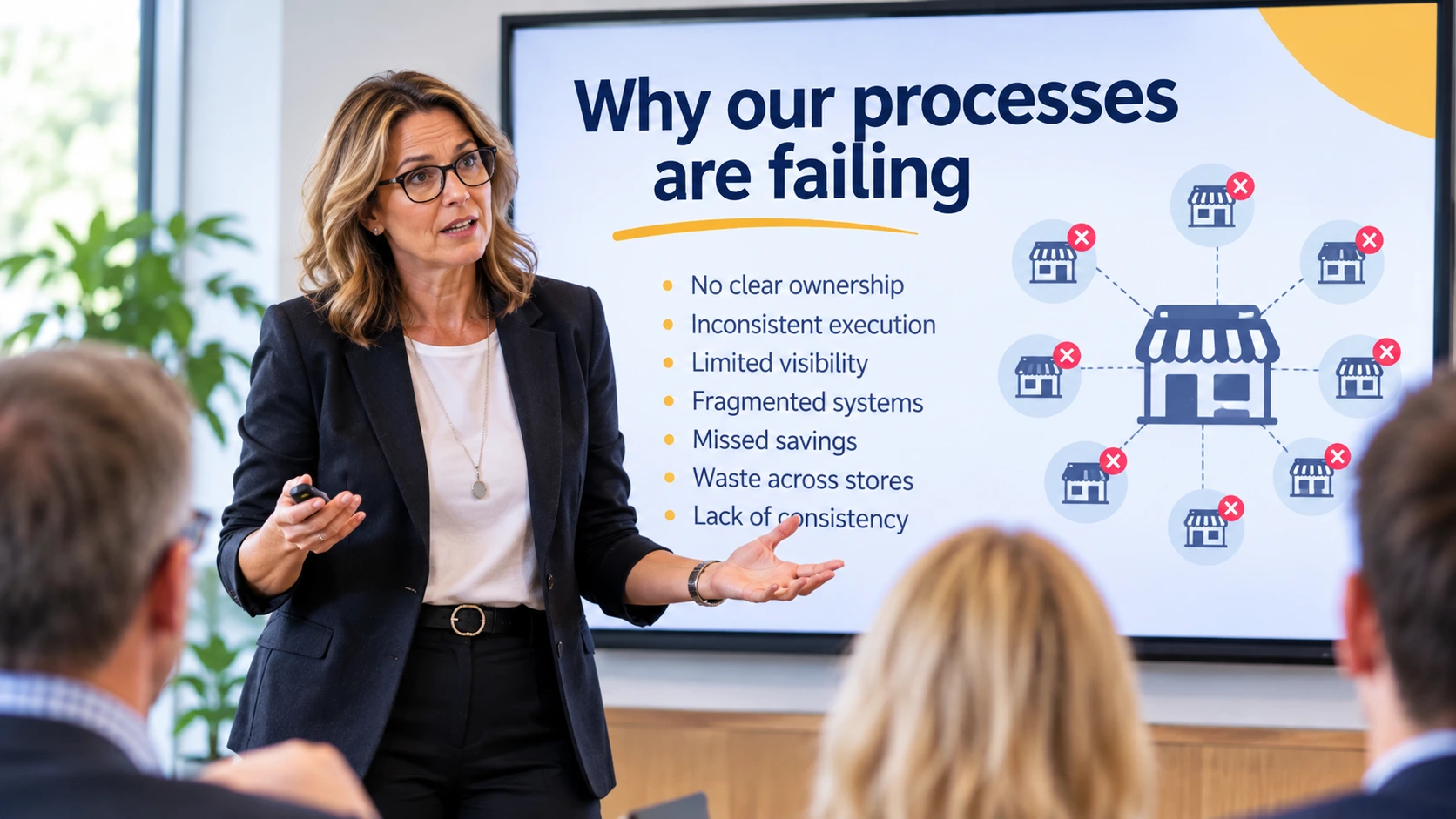
Retail process improvement fails across multiple stores when there is no clear owner, no visibility of store-level adoption, and no single source of data. Supplier sprawl, untracked costs, hidden backroom waste and treating change as a one-off project all add to the chaos. Acopia’s 7Cs framework uncovers each of these gaps.
Picture a retailer that signs off a new ordering process, tests it in a handful of stores and it’s hailed a success. Six months on, one store has drifted back to its old supplier, another is buying carrier bags from Amazon and head office is looking at three different spend reports.
The plan wasn’t the problem. Nobody owned the adoption and therefore nobody could see it slipping. Improvements rarely fail at sign-off. They fail in the months after when nobody is watching.
When a retailer gets it right, the result is measurable. ProCook’s head office used to prepare orders for each of its 75 stores and stocktake every item on a spreadsheet each month, which took time and led to errors. After moving to MyAcopia, the errors were eliminated and one team member got 24 hours a month back, that’s 288 hours a year. Head office also gained control of one ordering process, visibility of what each store orders and a simpler, centralised product and supplier list.
Retail transformation programmes often stall on accountability and coordination between functions, but not on the strategy itself AlixPartners. For multi-site retailers, every extra store multiplies that misalignment. A change that’s a minor adjustment in one store becomes a problem across twenty and an operational risk across two hundred.
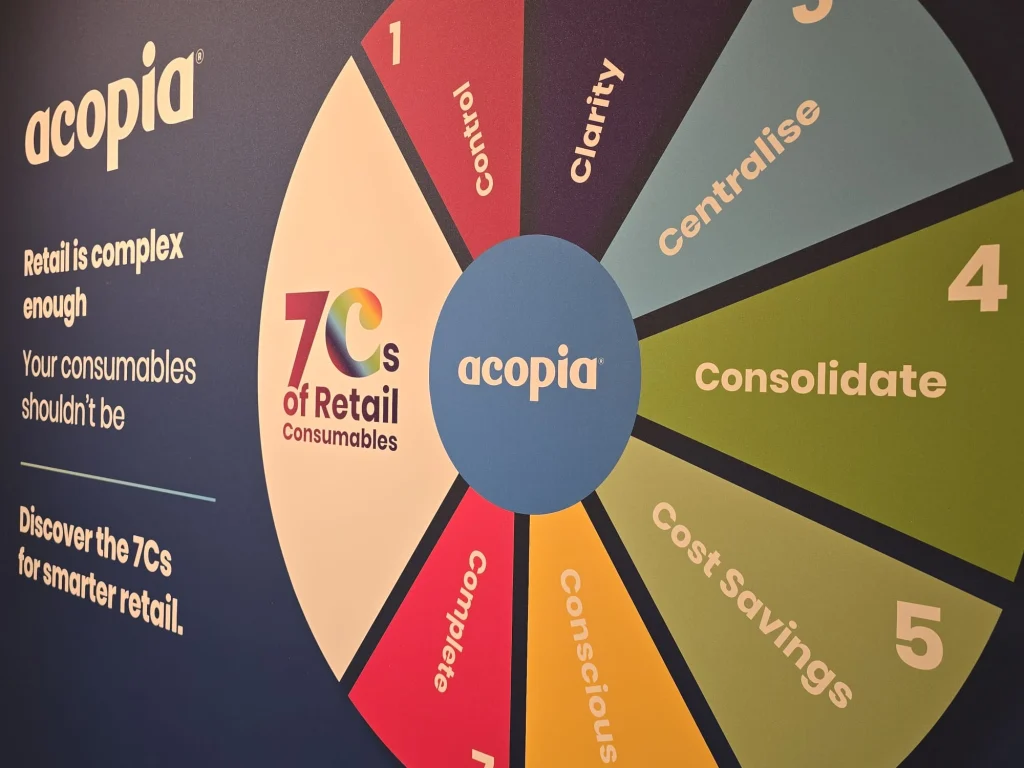
We group the causes into seven gaps: the 7Cs Control, Clarity, Centralised, Consolidated, Cost Savings, Conscious and Complete. This guide walks through each one, what it looks like when it breaks down and what closing it takes.
Inconsistent data, local variations and execution gaps all affect how a new process lands from one location to the next. Performance depends on how consistently you execute across the whole network, not on the quality of the original idea. A retailer can have the right strategy and still fail on the mechanics of rolling it out.
The number of people involved makes it harder still. Regional managers, procurement, IT and frontline staff all need to be on the same page at the same time. The sheer complexity of multi-site retail makes a structured framework even more critical.
Without clear governance over processes and the spend behind them, stores drift back to whatever’s easiest. If no one is explicitly accountable for stopping that drift, it goes unchallenged for months.
“You’ve got to have something inside you that says actually let’s stick to the rules.”
Joe Pennington, Retail Director (ProCook, Charles Tyrwhitt)
Stores often run on separate systems or spreadsheets, which makes consolidated reporting slow and error prone. If head office can’t see which stores have adopted a new process and which haven’t, “improvement” is a wish. The gap between what was signed off and what’s happening on the shop floor stays invisible until it becomes a full-blown problem.
“I will say to everybody: look at the data. It doesn’t need to be overly complex, it’s just there.”
Chris Rigg, Procurement Specialist (Dobbies, Proxima)
“Data is absolutely key. If you don’t have it, you can’t use it.”
Joe Pennington, Retail Director (ProCook, Charles Tyrwhitt)
Even where data exists, it’s often fragmented across store, regional and head office reporting, each showing different numbers. Slow communication channels mean store managers take longer to report issues, share what’s working or feed local insight back up the chain.
Without one source of truth that everyone looks at and talks about in the same language, every improvement conversation starts from a different set of facts.
“It’s that full visibility...having that one source of truth across the business that everybody’s speaking to.”
Zara Owen, Retail and Operations, Body Shop
Process drift builds as supplier and SKU numbers creep up. Every store solves the same problem slightly differently, with its own preferred supplier, its own product code and its own workaround. You’re probably spending too much on too many items simply because the housekeeping around how things are ordered has never been done.
The fix is fewer choices: agree a core range centrally and order it through one route.
Without store-level visibility of spend, improvements stay invisible. Savings only show up if someone is tracking them store by store. Otherwise they go unnoticed and unrepeated, and the business case for the next improvement gets harder to make. With costs rising across retail, proving what a change saved is what protects the P&L.
Time counts as a saving too. ProCook’s 24 hours a month of head office time is the kind of cost that only becomes visible once you measure it.
“The rising costs in Retail are outpacing revenue.”
Andy Kerr, Tefal
This is the easiest gap to miss because it rarely shows up as a failure. It costs money and stockroom space, and can quietly undermine sustainability targets. Retailers are increasingly having to manage overconsumption and back-of-house stock, including goods not for resale (GNFR), and most of the waste is visible without a deep investigation. A process improvement effort that ignores waste and sustainability in the backroom is solving half the problem.
“You don’t need to go too deep...to expose the stuff that is hiding in plain sight.”
Chris Rigg, Procurement Specialist (Dobbies, Proxima)
The final failure is the result of the previous six: treating process improvement as a one-off project instead of an ongoing discipline. Ownership, data, one source of truth, supplier discipline, measured savings and less waste are not separate initiatives. They work as one system, and each one weakens without the others.
Retailers who bring that back-of-house discipline to their operations see the benefit front of house.
“If that means streamlining back of house operations...the people they have on the shop floor are focused on the customer.”
Joe Pennington, Retail Director (ProCook, Charles Tyrwhitt)
Most improvement programmes treat rollout as a communications task. Effective project management in multi-site retail needs clear scope and an honest view of conflicting objectives, such as sustainability goals and procurement mandates.
Test the change in one or two representative stores first, and use this to identify who owns adoption and how head office sees this progress. Then keep a clear structure across the whole programme rather than renegotiating store by store as issues arise. That’s why the 7Cs work best applied together. A rollout is “done” when every store is doing it, not when every store has been told to.
Acopia shows a retailer where it stands on each of these areas through three support mechanisms:
Used together, the three give you a roadmap for implementing process improvement and keeping it going after go-live, which is what Complete is about.
“Our store teams have access to MyAcopia, we can set a monthly limit, they can see all the prices and this enables us to control costs.”
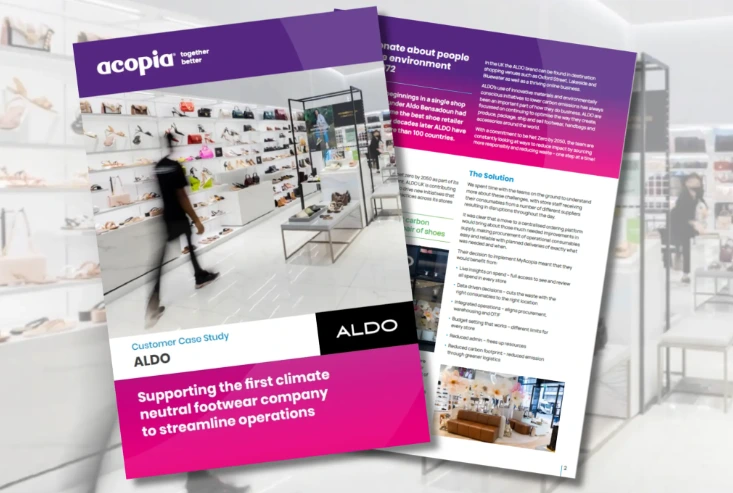
Mark Swinden, Retail Operations, ALDO
Learn more in our ALDO case study
To talk through where your own operation sits against the 7Cs, get in touch with the team or read our 48 page complete guide to implementing it across your estate.
A diagnostic model for multi-site retail operations covering seven areas where process improvement typically breaks down: Control, Clarity, Centralise, Consolidate, Cost Savings, Conscious and Complete.
It’s the work of standardising and improving how stores handle tasks such as ordering, stockroom management and supplier spend, so every site operates the same way and head office can see the results.
Most commonly because one or more of the 7Cs is missing. That means no clear owner (Control), no visibility of store-level adoption (Clarity), fragmented data between stores and head office (Centralise), too many suppliers and SKUs (Consolidate), no way to prove savings (Cost Savings), unchecked backroom waste (Conscious), or change treated as a one-off project (Complete).
Track it store by store against a baseline set before the change, using the same data source for every site. Look at what each store orders, from which suppliers, and how closely it follows the agreed process, rather than relying on head office sign-off.
Build measurement into the rollout itself. Track adoption per store and keep a short feedback loop from store teams back to whoever owns the programme. This maps directly to the Control and Clarity elements of the 7Cs.