


TL;DR
Retail consumables are essential to daily operations, yet they are rarely managed strategically. Fragmented purchasing, limited visibility and inconsistent processes quietly drive up cost, waste and operational risk. By treating consumables as a management issue rather than an administrative one, Retailers can begin to unlock sustainable improvements. The 7 Cs of Retail Consumables provides the framework and The Retail Consumables Maturity Index provides a clear starting point.
Retail is no stranger to complexity. Multi-site estates, tight margins, escalating operating costs and increasing regulatory pressure mean leaders are constantly searching for ways to improve efficiency and resilience. Significant attention is given to product ranges, pricing strategies, labour optimisation and supply chains.
Yet one critical area often escapes strategic scrutiny: operational consumables.
From cleaning materials, carrier bags, store supplies such as tickets, hangers, labels and till rolls, to back-of-house essentials - consumables underpin the day-to-day functioning of retail operations. They are ordered frequently, relied upon everywhere and essential to consistency in-store. Despite this, they are rarely treated as a category that requires active, ongoing management.
Instead, consumables are often viewed as unavoidable overheads, low value, and too complex to optimise. This assumption is quietly costly.
Consumables rarely fail in a way that demands immediate attention. There is no single point of breakdown. Instead, inefficiencies build gradually and largely unnoticed.
Across multi-site retail estates, familiar patterns emerge:
Individually, these issues may appear minor. At scale, they create inconsistency, inefficiency and unnecessary cost.
Industry analysts such as Gartner1 consistently highlight that areas of spend lacking visibility and governance are among the hardest to optimise. When ownership is unclear and data fragmented, management becomes reactive rather than strategic.
Consumables are rarely ignored deliberately. They fall through the cracks for structural reasons.
They sit between functions
Consumables typically touch operations, procurement, finance and sustainability. When responsibility is shared, accountability can become diluted.
They are operationally familiar
Because consumables are everyday items, they feel simple. This familiarity masks the complexity of managing them across large, distributed estates.
They are purchased in small values
Consumables are generally lower value items. Their true cost only becomes visible when procurement of these items is viewed collectively.
They are often managed locally
Local purchasing decisions are usually made with good intentions. Without consistent oversight, however, they introduce fragmentation.
The result is not poor execution by individuals, but a system that was never designed to manage consumables effectively at scale.
When consumables are not managed strategically, the impact extends well beyond cost.
Operational impact
Financial impact
Sustainability impact
The UK Government’s Resources and Waste Strategy for England2 highlights the importance of efficiency, transparency and better purchasing practices in reducing waste. Without structured consumables management, these ambitions are difficult to deliver in practice.
👉 Take the Retail Consumables Maturity Index Assessment here
To address these challenges, Retailers need to rethink how operational consumables are viewed.
Rather than treating them as:
Consumables should be managed as:
This shift does not require more bureaucracy. It requires better structure, clearer visibility and a consistent way of working.
The 7 Cs of Retail Consumables provides a practical framework for treating consumables as a management issue rather than an afterthought.
They are not a checklist, they represent a process that together, enable scalable and sustainable improvement.
Research by Deloitte3 into retail operations consistently shows that fragmented purchasing and inconsistent processes increase cost and waste while reducing control.
At a high level, the 7 Cs focus on:
Individually, each C addresses a specific challenge. Together, they form a structured approach to consumables management.
Why the order matters
One of the most common mistakes Retailers make is jumping straight to cost reduction or sustainability initiatives. Without the right foundations, these efforts are difficult to sustain.
The 7 Cs are designed as a progression:
👉 Take the Retail Consumables Maturity Index Assessment here
Recognising that consumables could be managed better is only the first step. The real challenge is understanding where to start.
Because consumables management spans multiple teams and processes, what feels “under control” in one area may appear fragmented in another. Without a clear baseline, improvement efforts risk being unfocused or misdirected.
To address this, Acopia has developed the Retail Consumables Maturity Index, a structured assessment designed to help Retailers understand how effectively their consumables are managed today.
Rather than focusing on how much is spent, the Index looks at how the system works.
It assesses maturity across the 7 Cs, helping Retailers identify:
From reactive to optimised
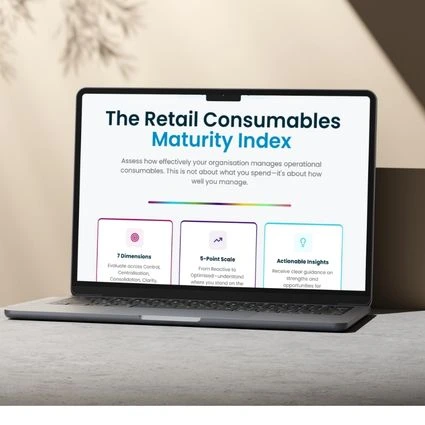
The Retail Consumables Maturity Index measures maturity across five clear stages:
Most Retailers find they operate at different levels across different Cs. This is normal and is exactly what the Index is designed to reveal.
What Retailers receive
On completion, the Retail Consumables Maturity Index provides:
The greatest gains are usually achieved by prioritising one or two areas rather than trying to fix everything at once.
Where do you sit on the index?
Understanding the maturity of your consumables management can be the difference between reactive fixes and meaningful improvement.
The Retail Consumables Maturity Index provides a clear starting point, helping Retailers to begin addressing consumables as the management issue they truly are.
👉 Take the Retail Consumables Maturity Index Assessment here
Operational consumables may never be the most visible part of retail strategy, but they touch every store, every team and every day of operation.
Getting ready for what comes next
Retail consumables are not just items on an order list. They are a reflection of how well operations are governed, understood and managed.
By reframing consumables as a management issue, and understanding current maturity, Retailers can move from reactive problem-solving to structured, scalable improvement.
The 7 Cs provide the framework. The Retail Consumables Maturity Index provides the starting point.
References